Have any Questions?
+91 73833 21779
Mail us today
connect@aadharshila.com
Brand Identity Prism: Kapferer’s 6 Facets Explained (India)
August 18, 2026
aadharshila
No Comments
Key Highlights
- The Brand Identity Prism is a six-facet model that turns an abstract brand into a defined, repeatable system.
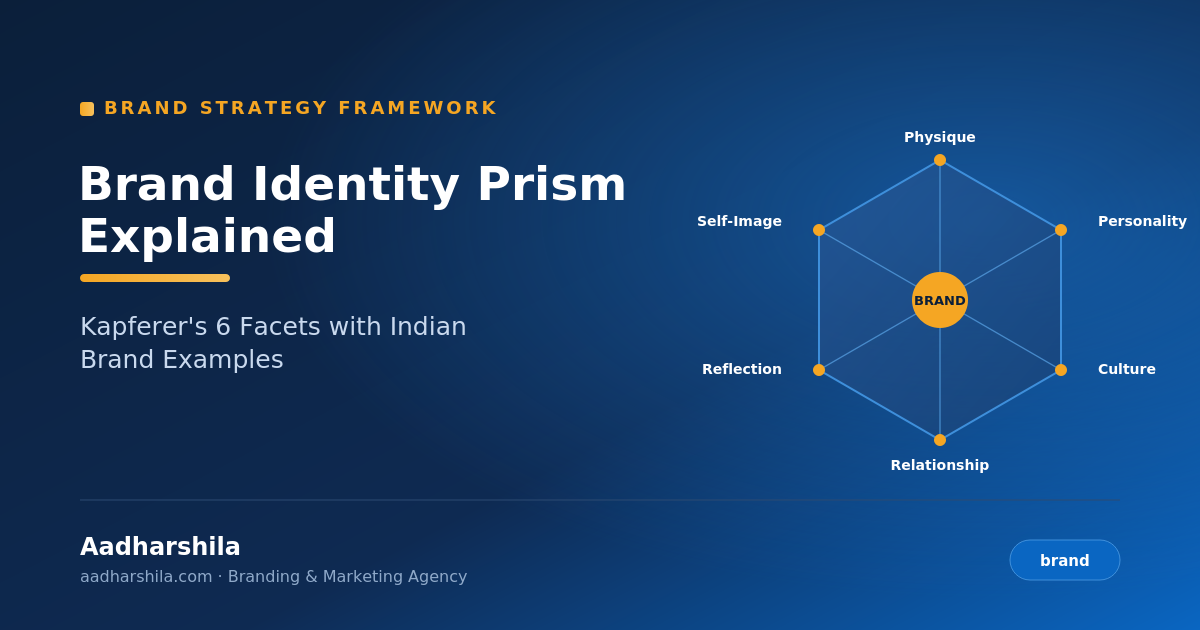
- Its six facets are physique, personality, culture, relationship, reflection and self-image.
- Two axes organise the prism: sender versus recipient, and external versus internal.
- Indian brands such as Royal Enfield, Amul and Tata show all six facets working together.
- The prism fixes the single biggest branding problem for growing firms, which is inconsistency across touchpoints.
- You can build your own prism in a focused workshop before any logo or campaign work begins.
In This Article
Most brands do not fail because of a weak logo. They fail because the logo, the tone of voice, the packaging, the social feed and the sales pitch each tell a slightly different story. Customers feel the mismatch even when they cannot name it, and trust quietly leaks away. The Brand Identity Prism exists to close that gap. It is a simple framework that forces every part of a brand to agree on one identity before a single design file is opened.
At Aadharshila’s branding solutions team, the prism is one of the first tools we reach for when a company wants to look and sound like a single, confident brand rather than a collection of disconnected assets. This guide breaks the model down facet by facet, maps it onto well known Indian brands, and shows you how to build your own. If you are weighing up whether a full branding exercise is worth it, our overview of the work a branding agency actually does is a useful companion read, and you can learn how our studio approaches brand building before you begin.
- What Is the Brand Identity Prism?
- Identity vs Image: What the Prism Solves
- How the Prism Is Structured: The Two Axes
- Physique and Personality: The Picture of Sender
- Culture and Relationship: Values and the Bond
- Reflection and Self-Image: The Picture of Recipient
- The Prism Applied: Six Indian Brands
- How to Build Your Own Brand Identity Prism
- The Prism vs Other Brand Models
- Aadharshila Helps Brands Across India and Worldwide
- Related Reading
- Frequently Asked Questions
1. What Is the Brand Identity Prism?
The Brand Identity Prism is a strategic model that defines a brand through six connected facets arranged around a hexagonal shape. It was developed by the French branding scholar Jean-Noel Kapferer, who pioneered the concept of brand identity in Europe in 1986 and later set out the prism in full in his book The New Strategic Brand Management, published by Kogan Page. The name is deliberate. Just as a glass prism splits white light into distinct colours, Kapferer’s prism splits the single idea of a company into the separate elements that give it meaning. The six facets are physique, personality, culture, relationship, reflection and self-image. Each one answers a different question about the brand, and the real value lies in the agreement between them. A sharp visual identity cannot rescue a brand whose culture, customer relationship and self-image all point in different directions. The prism is not a scoring sheet. It is a source of truth that keeps a growing team from drifting apart as more people start making brand decisions. The framework has become a fixture in MBA programmes and agency workshops precisely because it is comprehensive yet practical, as Kapferer’s own reference text demonstrates across dozens of global case studies.Also Read10 Benefits and Advantages of Branding for a plain-language case on why a defined brand is worth the investment.
2. Identity vs Image: What the Prism Solves
The prism only makes sense once you separate two ideas that are often confused: brand identity and brand image. Brand identity is what the company deliberately sends out. It is the intended meaning, chosen on purpose and controlled from the inside. Brand image is what lands on the other side, the perception that actually forms in the customer’s mind after they have seen your website, met your salesperson, unboxed your product and scrolled your feed. These two are never identical, but the goal of good branding is to keep them close. When identity is vague, every team fills the gap with its own interpretation, and the received image scatters. The prism gives identity a fixed shape so that the image received stays faithful to the meaning sent. This is why we treat brand definition as the foundation of long term value rather than a cosmetic exercise, a point explored in our piece on the role of branding in long term brand value.
Identity is the message you send. Image is the message they receive. The prism is the tool that keeps the two from drifting apart as your business grows.
3. How the Prism Is Structured: The Two Axes
Before looking at the six facets one by one, it helps to understand the two axes that organise them. Getting these axes right is what separates a real prism from a list of adjectives, and it is where most first attempts go wrong.Axis one: sender versus recipient
The vertical axis runs between the brand as sender at the top and the customer as recipient at the bottom. Physique and personality sit on the sender side, because they describe what the brand puts out into the world. Reflection and self-image sit on the recipient side, because they describe the customer. Culture and relationship bridge the two, connecting who the brand is with who the customer becomes.Axis two: external versus internal
The horizontal axis separates the visible, social facets from the internalised ones. Physique, relationship and reflection are external, because they involve a two way exchange that others can observe. Personality, culture and self-image are internal, because they live inside the brand’s own spirit or inside the customer’s private sense of self. A helpful walkthrough of these four groupings is available in this breakdown of the prism’s structure.4. Physique and Personality: The Picture of Sender
The top half of the prism is what the brand actively constructs and projects. These are the facets you have the most direct control over, and they are usually where design work begins.Physique
Physique is the set of physical and sensory features that make a brand recognisable: the logo, the colour palette, the typography, the packaging shape, even a signature sound. It is the tangible skeleton of the brand. Think of Amul’s red and white identity anchored by the polka dotted Amul girl, or Royal Enfield’s teardrop fuel tank and unmistakable engine thump. Physique is where a strong logo design and a deliberate brand colour system do their work, supported by the typography choices that carry a brand’s voice on the page. All of this is the domain of graphic design, and it is the most visible facet, but on its own it is only one sixth of the story.Personality
Personality is the character the brand would have if it were a person. It shows up in tone of voice, wit, warmth or seriousness. Amul’s decades of topical, pun heavy hoardings give it a personality that is playful and quietly clever. Fevicol built a personality on gentle humour and the idea of an unbreakable bond. Personality is internal to the sender, which is why it should be defined in words before it is expressed in visuals, and why the logo a business chooses should follow from its personality rather than the other way around.Also ReadThe Importance of a Logo for Businesses to see how physique and personality meet in a single mark.
5. Culture and Relationship: Values and the Bond
The middle band of the prism connects the brand to the customer. These two facets are often skipped in rushed brand exercises, and skipping them is exactly why so many brands feel hollow.Culture
Culture is the value system and the origin story that feed the brand. It is the set of principles the brand draws on and the roots it grows from. Tata’s culture of trust, ethics and nation building is arguably its single most valuable asset, shaping how every group company behaves. Royal Enfield’s culture leans on heritage, engineering pride and a made in Chennai lineage. Amul’s culture is inseparable from its farmer owned cooperative model. Culture cannot be invented in an afternoon, which is one reason it is such a durable source of differentiation. Codifying it clearly is part of what we mean by good branding practice.Relationship
Relationship is the nature of the exchange between the brand and its customers, the implicit deal about how the brand behaves toward the people who choose it. Tata offers a relationship built on reliability and reassurance. Royal Enfield offers belonging, expressed through community rides and a sense of brotherhood among owners. Asian Paints casts itself as a partner in the emotional project of making a house a home. This bond increasingly plays out across digital channels, which is why the relationship facet is closely tied to how a brand shows up on social media.Not sure which facets your brand is getting wrong?
A short brand identity session with our strategists can map all six facets for your business and expose the contradictions before they cost you customers.Start a Brand Enquiry
6. Reflection and Self-Image: The Picture of Recipient
The bottom half of the prism belongs to the customer. This is the half brands most often misread, usually by collapsing two different ideas into one.Reflection
Reflection is the outward, stereotyped picture of the brand’s typical user, the person the wider world pictures when they think of the brand. It is important to note that reflection is not the same as the target audience. Royal Enfield’s reflection is the rugged, independent minded rider chasing the open road, even though the actual buyer might be a thirty five year old professional in a city. Reflection is external, a social image others can recognise.Self-Image
Self-image is the inner mirror. It is how customers see themselves, or want to see themselves, when they use the brand. A Royal Enfield owner may feel more adventurous and free the moment they twist the throttle. A Fabindia shopper may feel more culturally rooted and conscientious. Self-image is internal and private, and it is the deepest lever a brand can pull, because it ties the purchase to the customer’s own identity. Digital experiences shape this facet too, which is why a considered website design matters, and why brands must think carefully about how they behave in the era of social first branding.Also ReadBranding in the Age of Social Media for how reflection and self-image travel across feeds and stories.
7. The Prism Applied: Six Indian Brands
Theory becomes clear when you see all six facets fixed on a single brand. The table below maps the prism across three Indian brands that most readers will recognise instantly. Notice how the facets reinforce one another rather than competing. That coherence is exactly what makes these brands feel solid.| Facet | Royal Enfield | Amul | Tata |
|---|---|---|---|
| Physique | Teardrop tank, single cylinder thump, retro silhouette | Red and white palette, the Amul girl mascot | Blue T in an oval, a consistent group signature |
| Personality | Understated, rugged, unhurried | Witty, topical, warm | Serious, dependable, understated |
| Culture | Heritage engineering, made in Chennai pride | Farmer owned cooperative, taste of India | Trust, ethics, nation building |
| Relationship | Belonging and brotherhood among riders | Everyday household companion | Reliability and reassurance |
| Reflection | The free spirited, individualist rider | The value seeking, sensible Indian family | The prudent, quality conscious buyer |
| Self-Image | Adventurous and free | Smart and rooted in home values | Responsible and discerning |
Brand identity is not a soft cost. India’s 100 most valuable brands were worth a combined US$523.5 billion in 2025, about 13 percent of national GDP, according to the Kantar BrandZ ranking. Kantar specifically credits Royal Enfield’s deep loyalty to its immersive community, a textbook example of the relationship and self-image facets at work. The headline figures are also summarised by the India Brand Equity Foundation.
You can see the same coherence in the work we do for clients. Our branding portfolio shows how physique, personality and relationship are made to agree across real projects, and the Checkmate Group case study is a good example of a full identity built to hold together.
8. How to Build Your Own Brand Identity Prism
You do not need to be a global brand to use the prism. Any business with a name, a mark and customers already has all six facets, whether it has defined them or not. The exercise below turns them from accidental to intentional.Step 1: Start with culture and personality
Resist the urge to begin with the logo. Begin with the two internal sender facets. Write down the values your brand genuinely holds and the character it would have as a person. These two anchor everything above and below them, and this is exactly the material that later belongs in a formal brand guidelines document.Step 2: Define the relationship and the two customer facets
Decide what kind of relationship you want with customers, then describe the reflection, the outward image of your typical user, and the self-image, how you want customers to feel about themselves. Be honest about the difference between the two. Confusing them is the most common mistake in the entire exercise.Step 3: Translate into physique last
Only now should you brief the visual work. When physique is designed to express a defined culture, personality and relationship, the logo, colours and typography almost choose themselves. This is why we insist on documenting the upper facets before design, a discipline covered in our guide to a brand guidelines document and in our view on how branding helps you stand out in a digital age.
A useful test: if any two facets contradict each other, one of them is wrong. A premium self-image cannot survive a cheap physique, and a rebellious personality cannot sit inside a corporate, risk averse culture.
9. The Prism vs Other Brand Models
The prism is not the only identity framework, and it works best alongside others rather than against them. The comparison below shows where each model is strongest so you can choose the right tool for the job.| Model | Core idea | Best used for |
|---|---|---|
| Kapferer Brand Identity Prism | Six facets balancing sender and recipient | Defining a complete, internally consistent identity |
| Aaker Brand Identity System | Brand as product, organisation, person and symbol | Large portfolios and structured brand audits |
| Keller CBBE Pyramid | Building from awareness up to resonance | Tracking how customer perception and loyalty grow |
| Sinek Golden Circle | Start with why, then how, then what | Sharpening purpose and a founding message |
Key Takeaways
- The Brand Identity Prism defines a brand through six facets that must agree with one another.
- Two axes matter: sender versus recipient, and external versus internal.
- Reflection is the outside view of your typical user, self-image is how customers feel about themselves.
- Build the prism from the inside out, starting with culture and personality, ending with physique.
- Consistency across every facet is the real payoff, and it is measurable in brand value.
10. Aadharshila Helps Brands Across India and Worldwide
A defined prism is only useful when it is executed consistently across every market you operate in. Aadharshila builds and applies brand identity systems for clients based in Gujarat, across India and internationally, keeping physique, personality and relationship coherent wherever the brand appears.Branding Across India
Branding Internationally
11. Related Reading
Articles
Services
Ready to give your brand one clear identity?
Aadharshila maps your full brand identity prism, then designs every touchpoint to match. Turn a scattered brand into a consistent, memorable one.Book a Brand Consultation
12. Frequently Asked Questions
What is the Brand Identity Prism?
The Brand Identity Prism is a strategic model created by Jean-Noel Kapferer that defines a brand through six connected facets: physique, personality, culture, relationship, reflection and self-image. It helps a business codify who the brand is so that every touchpoint tells the same story.Who created the Brand Identity Prism and when?
The model was created by the French branding scholar Jean-Noel Kapferer, who pioneered the concept of brand identity in Europe in 1986. It was later detailed in his book The New Strategic Brand Management, published by Kogan Page.What are the six facets of the Brand Identity Prism?
The six facets are physique (physical and visual traits), personality (the brand’s character), culture (its value system and origin), relationship (the bond with customers), reflection (the typical customer as seen from outside) and self-image (how customers see themselves through the brand).What is the difference between reflection and self-image?
Reflection is the outward, stereotyped picture of the brand’s typical user, the person others imagine when they think of the brand. Self-image is the inner mirror, how a customer feels about themselves when they use the brand. Reflection is external and social, self-image is internal and private.What is the difference between brand identity and brand image?
Brand identity is what the company deliberately sends out, its intended meaning and expression. Brand image is what the audience actually receives and perceives. The prism works on the identity side, giving teams a source of truth so the received image stays close to the intended one.Is the Brand Identity Prism still relevant for digital brands?
Yes. Digital multiplies the number of touchpoints and the number of people executing a brand across websites, social feeds, packaging and ads. The prism keeps voice, design and behaviour coherent across all of them, which matters more, not less, in a digital first market.How is the prism different from Aaker’s model?
Kapferer’s prism is a six facet structure that balances the sender and the recipient of a brand. Aaker’s Brand Identity System organises identity around the brand as product, organisation, person and symbol. The prism is stronger at linking the brand to the self-image of its customer.Can a small business use the Brand Identity Prism?
Yes. Any business with a name, a logo and customers has all six facets whether it defines them or not. Filling in the prism forces a small business to decide its personality, culture and customer relationship on purpose rather than by accident, which is where most consistency problems start.Category
Recent Posts
- 12 Branding Strategies That Work for Small Businesses
- Annual Report Design: Turning Data Into a Brand Story
- Types of Branding: The 9 Types Every Business Should Know
- Brand Identity Prism: Kapferer’s 6 Facets Explained (India)
- Instagram vs LinkedIn vs Facebook: Which Platform Delivers Best ROI for Indian B2B?
Address
Reg. Office: 34, Third Floor, Meghdhanush, Race Course, Vadodara 390007
Corporate Office : 713 to 716, Supremus II, Near New Court,
Beside R K Plaza, 30 Mts. Road, Diwalipura, Vadodara 390 007, Gujarat, India
2026 Copyright Aadharshila. All Rights Reserved.